
Execution Architecture at Machine Speed
Governing Non-Human Authority, Runtime Isolation, and Deterministic Enforcement in Enterprise Intelligence Infrastructure
The evolution of enterprise AI agents performing operational work necessitates dedicated architectural controls for identity, security, runtime, and governance to manage execution.
Opinion · AI-assisted, human edited
Executive Summary
Enterprise artificial intelligence (AI) is evolving beyond systems that solely generate information or recommendations. AI agents are increasingly designed to interact with applications, data, APIs, tools, and enterprise workflows on behalf of users and organizations. This shift raises a fundamental architectural question: When an AI system has the capability to perform an action, what determines whether that action is actually permitted to execute?
This distinction is critical. A system might technically possess the capability to initiate a payment, modify a record, invoke an API, create an account, change a configuration, or trigger a business process. However, technical capability alone does not establish organizational authority. This leads to a central principle for enterprise AI: Capability ≠ Authority.
The challenge therefore extends beyond model intelligence, becoming an execution-control problem. This involves identity, context, policy, authorization, risk, approval, runtime isolation, execution, and evidence.
Recent developments underscore the importance of this problem. In February 2026, NIST launched its AI Agent Standards Initiative, focusing on secure operation, interoperability, agent security, and identity. NIST also published a concept paper examining identity and authorization for software and AI agents, including identification, authorization, auditing, non-repudiation, and mitigation of prompt-injection risks.
At the infrastructure layer, AWS has expanded Amazon Bedrock AgentCore with multiple runtime models. Its September 2026 release introduced a serverless microVM runtime with hardware-enforced session isolation, while its August 2026 Runtime Instances release provides persistent managed compute for longer-running agent workloads.
These developments do not establish a universal architecture for enterprise agents. Instead, they demonstrate a broader architectural direction: agent execution increasingly requires dedicated identity, security, runtime, and governance controls. For enterprise architecture, the important question is not simply, "Can the agent execute?" but rather, "Under what identity, in what context, under which policy, with what authority, at what level of risk, and subject to which controls can the execution occur?"
1. From AI Capability to AI Execution
Traditional enterprise software generally operates through predefined permissions and deterministic application logic. An AI agent introduces an additional layer of complexity. The agent may interpret objectives, select tools, determine intermediate steps, and interact with multiple systems dynamically. This flexibility creates a new boundary between what a system can technically do and what the enterprise permits it to do.
Consider a simplified example: An enterprise may provide an AI agent with access to a financial system capable of initiating payments. The agent may technically possess the API permission required to initiate a transaction. However, this does not automatically mean every payment is authorized. A policy might require:
- a maximum transaction amount
- a specific business unit
- a particular account
- a defined vendor
- segregation of duties
- human approval above a threshold
- additional verification for unusual activity
- complete prohibition under specific conditions
The agent, therefore, needs more than just access; it needs contextual authority. This distinction becomes increasingly important as AI systems transition from conversational interfaces toward operational execution.
2. The Emerging Execution Control Problem
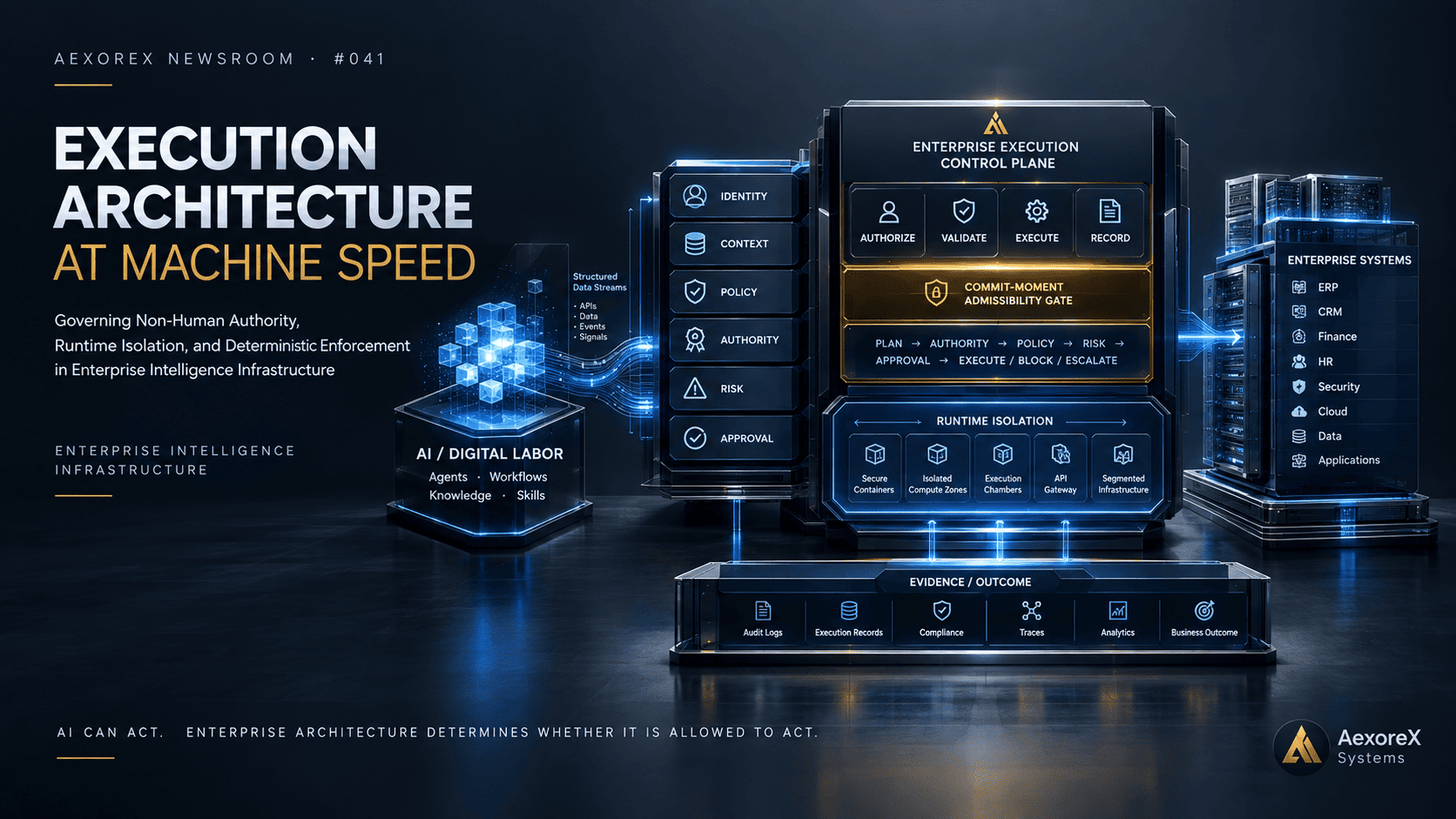
The enterprise AI execution problem can be represented as a chain: Identity → Context → Policy → Authority → Risk → Approval → Execution → Evidence → Outcome. Each component addresses a different question:
**Identity:** Who or what is requesting the action? This could involve a human user, an AI agent, a software identity, a service account, or another non-human identity.
**Context:** Under what circumstances is the request being made? Context may include the user, organization, transaction, environment, time, location, system state, business process, and relevant data.
**Policy:** What rules apply? Policies define permitted, restricted, conditional, and prohibited actions.
**Authority:** What is this identity actually allowed to do? Authority should be bounded by role, scope, context, policy, and delegated permissions.
**Risk:** What could happen if the action is executed? Risk assessment may consider transaction value, sensitivity, destination, anomaly signals, business impact, and other relevant factors.
**Approval:** Is additional authorization required? Some actions may be executed automatically, while others may require human or organizational approval.
**Execution:** Where and how is the action actually performed? This refers to the runtime layer.
**Evidence:** What information demonstrates what happened? Execution records, decisions, identities, policies, approvals, and system responses can contribute to an evidence trail.
**Outcome:** What actually happened as a result? The final outcome becomes part of the enterprise operating record.
3. Runtime Is Becoming an Architectural Boundary
AI agents do not execute in an abstract environment. They require compute, networking, credentials, operating environments, tool access, state, and connections to external systems. This makes runtime architecture an integral part of enterprise control.
AWS provides a useful example of this evolution. Amazon Bedrock AgentCore's current runtime architecture includes a serverless microVM-based option. AWS also provides Runtime Instances for workloads requiring longer-running or specialized compute. AWS describes the microVM runtime as supporting sessions of up to eight hours and Runtime Instances as supporting sessions of up to fourteen days. AWS also details hardware-enforced session isolation in its September 2026 AgentCore Runtime release.
The architectural significance extends beyond the specific AWS implementation, illustrating a core principle: The environment in which an agent executes can become part of the security and governance boundary. Runtime controls can potentially determine:
- what resources an agent can access
- which credentials are available
- which network destinations are reachable
- what state can persist
- how sessions are isolated
- how execution is observed
- how workloads are terminated or constrained
This does not mean that every enterprise requires microVMs, nor does it imply that runtime isolation alone establishes authorization. Instead, runtime security becomes one layer within a larger control architecture.
4. Identity Becomes More Important as Agents Become More Autonomous
An AI agent acting on behalf of an organization raises a question that traditional Identity and Access Management (IAM) systems were not always designed to answer directly: What identity represents the agent, and what authority does that identity possess?
NIST's February 2026 concept paper specifically examines applying identity standards and practices to software and AI agents. It identifies areas including identification, authorization, auditing, non-repudiation, and controls related to prompt injection.
This points toward a broader enterprise requirement: AI agents should not simply inherit unrestricted authority from the humans or systems around them. Instead, enterprises may need mechanisms for:
- distinct non-human identities
- scoped credentials
- delegated authority
- contextual authorization
- permission expiration
- revocation
- separation of duties
- auditable actions
The exact implementation will vary by enterprise architecture, but the underlying requirement is consistent: An autonomous actor requires an explicit relationship between identity and authority.
5. The Commit-Moment Problem
A particularly important architectural question arises immediately before a consequential action is committed. An agent may have received an instruction, interpreted the objective, retrieved information, selected a tool, generated parameters, and passed several intermediate checks, finally reaching an enterprise transaction. However, the state of the world may have changed during these steps. A user's authorization may have expired, a policy may have changed, a transaction amount may have changed, a risk condition may have appeared, or another system may have modified the underlying record.
This creates what AexoreX refers to as a Commit-Moment Admissibility Gate.
AexoreX architectural proposal > The Commit-Moment Admissibility Gate is not presented as an existing industry standard. It is an AexoreX architectural concept for considering whether a consequential action should be re-evaluated immediately before execution.
Conceptually, this process unfolds as:
Intent ↓ Plan ↓ Tool / API Request ↓ Current Identity ↓ Current Context ↓ Current Policy ↓ Current Authority ↓ Current Risk ↓ Approval Requirement ↓ Admissibility Decision ↓ Execute / Block / Escalate
This creates a final control boundary between planning and consequential execution. The objective is not to assume that a model is deterministic, but rather to place deterministic enterprise controls around a system whose reasoning may be probabilistic.
6. Separating Reasoning From Enforcement
Large language models are designed to interpret and generate information. Enterprise authorization systems have a different responsibility: they must enforce boundaries. This suggests an architectural separation:
**Probabilistic layer:** The AI model may interpret objectives, reason over information, generate plans, select tools, propose actions, and adapt to changing circumstances.
**Deterministic control layer:** The enterprise control system may verify identity, evaluate policy, determine authority, enforce limits, require approval, block prohibited actions, record execution, and generate evidence.
The goal is not necessarily to make the model itself responsible for enforcing every enterprise rule. Instead: Let intelligence reason. Let enterprise controls decide what is admissible. Let the execution environment enforce the boundary. This separation is an architectural principle, not a claim that one implementation is universally required.
7. A Conceptual Privilege-Boundary Model
AexoreX proposes the following conceptual model for reasoning about execution boundaries:
**Ring 0 — Core Policy and Authority Controls:** This is the most protected control layer. Potential responsibilities include policy evaluation, authority determination, transaction constraints, approval requirements, and execution admissibility.
**Ring 1 — Enterprise Integrations and Identity:** This layer connects authorized execution to IAM, enterprise applications, APIs, databases, financial systems, and operational systems.
**Ring 2 — Agent Orchestration:** This is the agent's planning and coordination layer. Potential responsibilities include task decomposition, planning, tool selection, workflow coordination, and contextual reasoning.
**Ring 3 — Model Output and External Inputs:** This is the least trusted decision-input layer. Potential sources include model-generated content, external data, user-provided content, retrieved documents, and third-party tool responses.
This model is an AexoreX conceptual architecture, not an industry-standard privilege-ring specification. Its purpose is to illustrate a basic principle: The closer an AI-generated instruction gets to consequential enterprise execution, the stronger and more deterministic the control boundary should become.
8. MCP and the Expanding Tool Interface
Agent interoperability is also changing the execution architecture. The Model Context Protocol (MCP) continues to evolve as an interface for connecting AI applications with tools and external resources. The July 28, 2026, MCP specification introduced a stateless protocol core, multi-round-trip requests, header-based routing, authorization hardening, and other changes.
The importance for enterprise architecture is not that MCP itself becomes an authorization system. Rather, as standardized interfaces make it easier for agents to interact with external tools, the number of possible execution paths increases. This makes the surrounding control architecture more important.
A useful distinction is: MCP can help an agent communicate with a tool, but it does not by itself answer whether a particular agent should be authorized to perform a particular action under a particular context. That decision remains an enterprise governance problem.
9. Digital Labor Requires Bounded Authority
As enterprises move toward AI agents performing operational work, the concept of Digital Labor becomes increasingly relevant. A Digital Worker may interact with enterprise systems similarly to other software actors. However, increased autonomy should not imply unlimited authority.
A conceptual autonomy spectrum can therefore be expressed as:
**Stage 1 — Assistive:** AI recommends; human executes.
**Stage 2 — Supervised:** AI prepares and executes within an explicit human-supervised workflow.
**Stage 3 — Conditional Bounded Autonomy:** AI executes automatically when predefined conditions are satisfied. Exceptions are escalated.
**Stage 4 — Autonomous Within Defined Boundaries:** AI operates independently within a formally defined authority boundary. Actions outside that boundary require additional control.
The important principle is: Autonomy should expand within boundaries, not eliminate boundaries.
10. The Enterprise Authority Control Plane
This leads to a broader architectural proposition. Enterprise AI may benefit from a control plane that sits between Human/Organizational Authority and Digital Labor/AI Execution.
Conceptually:
Human Executive Authority ↓ Enterprise Authority Control Plane ↓ Non-Human Identity / Digital Worker ↓ Runtime Execution Environment ↓ Enterprise Systems
The control plane can conceptually coordinate identity, context, policy, authority, risk, approval, execution constraints, evidence, and outcome. This is the architectural territory in which AexoreX positions AEOS Enterprise Authority™.
The proposition is not that AEOS replaces enterprise applications, cloud platforms, identity systems, or agent runtimes. Rather, AEOS is designed around the idea of connecting, orchestrating, governing, and activating the existing enterprise stack.
11. Vendor Independence by Design
The evolution of agent runtimes creates another strategic architectural question: Should an enterprise control plane depend entirely on one runtime provider? A heterogeneous enterprise may use multiple cloud platforms, AI models, agent frameworks, runtimes, identity providers, enterprise applications, integration platforms, and observability systems.
For that reason, AexoreX defines Vendor Independence by Design™ as an architectural principle. The objective is not to reject external vendors, as external platforms can accelerate development and provide capabilities that would otherwise require substantial engineering. The architectural objective is to prevent the enterprise intelligence layer from becoming inseparably coupled to a single provider.
This suggests a model of:
Vendor Capability → AEOS Abstraction → Enterprise Policy & Authority → Multiple Execution Environments
Where appropriate, runtime-specific adapters can allow the governance layer to interact with heterogeneous infrastructure without requiring the enterprise authority model to be rebuilt for every underlying provider.
12. What Remains Unsolved
The industry has not solved every problem associated with autonomous enterprise execution. Important challenges remain:
- **Cross-system transaction consistency:** An action may span multiple APIs or enterprise systems. If one operation succeeds and another fails, achieving consistent recovery can be difficult.
- **Indirect prompt injection:** Agents may encounter untrusted instructions embedded in data, documents, websites, or tool responses. Distinguishing data from authority remains a major security concern.
- **Confused-deputy problems:** An agent may possess access that exceeds the authority appropriate for a particular user, task, or context.
- **Cross-cloud authority portability:** Authority models may not map cleanly across different identity systems, cloud providers, runtimes, and enterprise applications.
- **Probabilistic reasoning versus deterministic accountability:** The AI may generate a probabilistic plan while the enterprise requires a deterministic explanation of why a consequential action was permitted.
These are architectural research areas—not problems that can be solved simply by adding a larger model.
13. The AexoreX Architectural Perspective
The developments described above lead to a straightforward architectural observation: AI intelligence alone is not an enterprise operating model. An autonomous enterprise requires a relationship between Intelligence, Authority, Execution, Evidence, and Outcome. This is the architectural territory AexoreX is exploring through AEOS QUANTUM™.
AEOS is designed around the sequence: Connect → Contextualize → Govern → Orchestrate → Authorize → Execute → Optimize. Evidence is treated as a cross-cutting requirement across the lifecycle rather than as a separate eighth stage.
The resulting conceptual chain is:
Identity → Context → Policy → Authority → Risk → Approval → Digital Labor → Runtime Control → Execution → Enterprise System → Evidence → Outcome
This is not a claim that every component is already production-ready within AEOS. AexoreX distinguishes its development status explicitly:
- **Available:** currently available capability
- **In Development:** actively being built
- **Designed:** architectural design defined
- **Planned:** intended future capability
- **Vision:** longer-term strategic direction
This distinction is essential for credible enterprise technology.
14. From Digital Labor to Autonomous Enterprise
The enterprise automation market has historically focused on workflows. Agentic systems introduce something different. Instead of simply following a predefined sequence, an agent may interpret objectives and dynamically determine how to achieve them. That creates both opportunity and risk.
The architectural question therefore changes from "How do we automate this workflow?" to "How do we give a digital worker enough authority to perform useful work while ensuring that authority remains bounded, contextual, observable, and revocable?"
That question sits at the intersection of AI, enterprise architecture, cybersecurity, identity, governance, workflow, runtime infrastructure, and operational accountability. The emerging autonomous enterprise will therefore not be defined solely by how intelligent its models are. It will also be defined by how precisely it can control what those models are allowed to do.
15. Conclusion
The next phase of enterprise AI is not simply about giving agents more capabilities. It is about making those capabilities operationally governable.
- A capable agent can propose an action.
- An authorized agent can perform an action.
- A governed agent can perform the action within defined conditions.
- A well-controlled enterprise can additionally establish evidence of who acted, under what context, under which policy, with what authority, after which approval, through which execution path, and with what outcome.
That is the distinction between an AI system that can act and an enterprise system that can safely delegate work. The architectural challenge ahead is therefore not "How autonomous can AI become?" It is "How precisely can enterprise authority govern autonomy?"
For AexoreX, that question leads directly to the next architectural layer: Evidence. If article #041 asks how execution should be controlled, article #042 will ask: How can an enterprise establish reliable evidence of what its AI systems actually decided, executed, changed, and achieved?
Sources and attribution
- AexoreX Newsroom / AexoreX Systems · statement link
About the author
The editorial team behind AexoreX Newsroom, the official corporate publication of AexoreX Systems LLC.
More from AexoreX Systems Editorial Team →Related stories
- #027 — Authority & Governance
- Governing Autonomous Execution: Enterprise Control Planes and the Shift to Digital Labor
- From Autonomous Execution to Enterprise Evidence
- The Identity-to-Execution Seam: Governing Non-Human Identities and Dynamic Delegation in Autonomous Enterprise Operations
- THE ARCHITECTURE OF DIGITAL AUTHORITY
- Authoritative Control Planes for Autonomous Digital Labor: Identity, Authority & Verifiable Execution
- Beyond AI: Building the Enterprise Operating Model for Intelligence, Digital Labor, Governance, and Execution.
- The Infrastructure Behind the Autonomous Enterprise: Building the Foundation for Enterprise Intelligence
- Governing Digital Labor: Bridging Capability and Authority in Autonomous Enterprise Architecture
- #025 — The Enterprise AI Inflection Point: From AI Agents to Governed Autonomous Operations