
THE ARCHITECTURE OF DIGITAL AUTHORITY
Governing Human and Non-Human Actors in Autonomous Enterprise Operations
As enterprise software shifts from assisting humans to autonomous action, a new architecture is needed to govern both human and non-human actors.
Opinion · AI-assisted, human edited
AexoreX Research & Institutional Intelligence Executive Intelligence
Enterprise software is undergoing a significant transition. For decades, enterprise systems were primarily designed to assist human workers. People made decisions and gave instructions, while software performed defined functions. This model is now changing with the emergence of Generative AI, Agentic AI, AI Agents, and Digital Labor.
Software is no longer limited to producing information. It can increasingly understand context, use tools, access applications, call APIs, perform tasks, and take actions on behalf of people or organizations. This shift introduces a new question for enterprises: it is no longer sufficient to ask what AI *can* do, but also what AI is *allowed* to do.
This question becomes even more critical when enterprise operations involve both human and non-human actors. Today's enterprise environments can include:
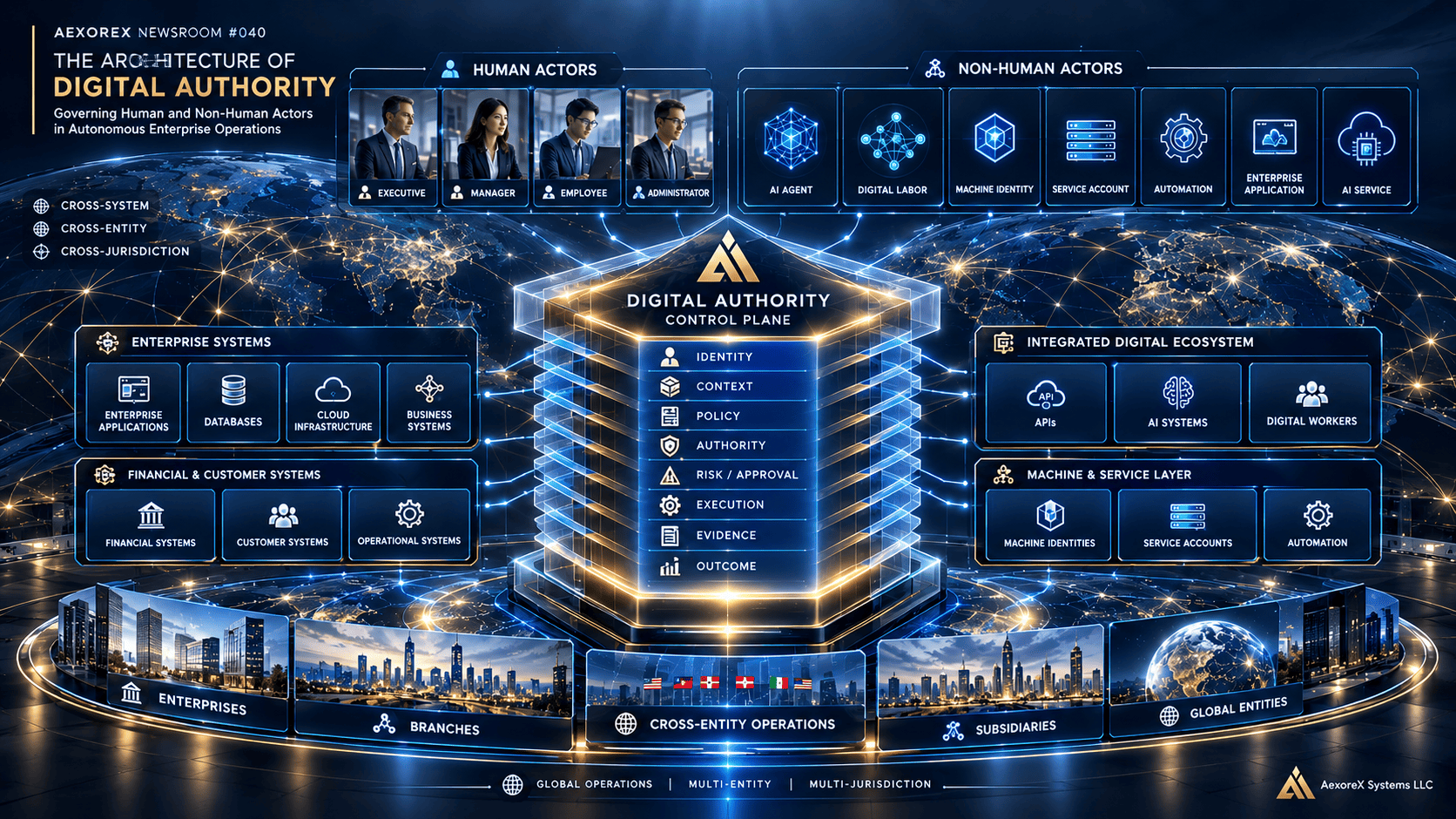
Human Actors: - Employees - Managers - Administrators - Executives
Non-Human Actors: - AI Agents - Digital Labor - Service Accounts - Applications - Automations - API Clients - Machine Identities - AI Services
All these actors can interact with enterprise systems. Consequently, future enterprise governance must extend beyond focusing solely on people to encompass understanding and controlling the actions of both human and non-human actors.
1. From Software That Helps to Software That Acts
Generative AI initially focused on producing text, code, summaries, analysis, and recommendations. Agentic AI expands upon this capability. An agent can be designed to receive a goal, understand context, plan actions, use tools, access external systems, perform actions, evaluate results, and continue working autonomously.
This establishes an important distinction between: - Information Generation - Operational Execution
An AI system that offers a recommendation differs fundamentally from an agent capable of changing customer data, creating a transaction, modifying a system configuration, or executing a business process. As AI moves closer to real-world business actions, the concept of authority becomes increasingly vital.
2. The Rise of Non-Human Actors
A significant development is the growth of Non-Human Identity (NHI). Non-human identities are utilized by applications, services, automation, service accounts, machine-to-machine communication, and AI-driven systems. An AI Agent may use a non-human identity.
However, Non-Human Identity is not synonymous with an AI Agent. AI Agents represent only one component within the broader non-human identity ecosystem. This presents a new governance challenge.
For a human user, organizations typically consider: Identity → Role → Permission → Access
For autonomous or semi-autonomous systems, the model becomes more intricate: Identity → Context → Policy → Authority → Risk → Approval → Execution → Evidence → Outcome
The organization must not only understand which technical identity is being used, but also the authority that identity possesses within a specific business context.
3. Capability Is Not Authority
A cornerstone principle for autonomous enterprise architecture is: Capability ≠ Authority.
An AI Agent may possess the technical capability to perform an action, but this does not automatically grant it the authority to do so.
Consider a simple example: An AI Agent has technical access to a financial system. Its capability is: The agent can create a transaction. The governance question, however, is: Is the agent authorized to create this transaction?
Further questions then arise: - For which entity? - For which business unit? - For what amount? - In which country? - Under what conditions? - Under which policy? - Does human approval need to be obtained? - What is the risk level? - How is the action recorded? - How can the organization prove what happened?
Therefore: - Access is not Authority. - Permission is not always Authority. - Capability is not Authority.
Authority must be understood within its specific context.
4. Authority Depends on Context
In a basic system, authorization might be understood as: "Does this identity have permission?" In a complex enterprise, the question expands to: "Does this identity have the authority to perform this action, on this object, in this context, at this time?"
Context may encompass: - identity - organization - legal entity - business unit - country - jurisdiction - system - data - transaction - customer - transaction value - risk level - time - policy - approval status
Consequently, authority cannot always be treated as a static attribute. In some situations, authority must be context-aware and dynamic.
5. Cross-System Operations
Modern enterprises rarely operate using a single application. A single business process might involve multiple systems such as ERP, CRM, ITSM, HR, Finance, Data Platform, Cloud, and AI Platform. For instance, Digital Labor might retrieve customer information from a CRM, check contract details in an ERP, create a request in an IT service system, and call an external service.
Therefore, authority cannot always be evaluated within one application. It may need to be understood across the entire action chain. This necessitates cross-system governance. The architectural principle here is not to replace existing enterprise systems, but rather to connect them with an intelligence and authority layer, allowing them to remain the systems of record and execution.
6. Cross-Entity Operations
Global enterprises also operate through multiple entities, for example: Parent Company ↓ Regional Entity ↓ Country Entity ↓ Business Unit ↓ Department
An agent with authority within one entity should not automatically possess the same authority within another. Therefore, authority must be linked to entity context. The question is not merely: "Does this agent have access?" but also: "On behalf of which entity is this agent acting?"
7. Cross-Jurisdiction Governance
Global companies often operate across various countries and legal environments. A single business process could span Indonesia, Singapore, Japan, the European Union, and the United States. Relevant requirements may vary based on: - where the operation takes place - where data is stored - which legal entity is involved - the type of transaction - the type of customer - the industry - applicable regulations - contractual obligations
Thus, global enterprise authority must also account for jurisdictional context. The more precise concept is Cross-Jurisdiction Governance, rather than simply "cross-country governance," as a jurisdiction can be more complex than a geographic boundary.
8. One Governance Model for Human and Non-Human Actors
The future enterprise may contain many different types of actors:
Human: - Employee - Manager - Administrator - Executive
Non-Human: - AI Agent - Digital Labor - Service Account - Application - Automation - API Client - Machine Identity - AI Service
All these actors can potentially be evaluated through a common control chain: Identity → Context → Policy → Authority → Risk → Approval → Execution → Evidence → Outcome
The differences lie in the identity type, source of authority, level of autonomy, controls, approval requirements, and execution mechanism. This offers an opportunity to construct a more unified governance model for both human and non-human operations.
9. When Authority Does Not Follow Context
Risk escalates when technical capability and access advance more rapidly than governance. Relevant risks include: - excessive privilege - credential misuse - orphaned machine identities - prompt injection - indirect prompt injection - context poisoning - insecure tool access - confused-deputy behavior - insufficient approval - weak auditability
The Air Canada chatbot case serves as a real-world example of how AI-generated information can have business and legal ramifications. In Moffatt v. Air Canada, the British Columbia Civil Resolution Tribunal found Air Canada liable for negligent misrepresentation due to information provided by its chatbot, rejecting the argument that the chatbot should be treated as a separate entity. While this case does not imply that every AI action creates the same legal responsibility, it illustrates a crucial principle: organizations must understand and govern the systems they deploy.
10. Human-in-the-Loop Is Not the Whole Answer
Human approval can provide a vital layer of control. However, requiring human approval for every action can lead to "Approval Fatigue." When approval requests become excessive, people may lose context, approve automatically, overlook important information, or become an operational bottleneck.
Future governance therefore needs to address better questions: - When should a human decide? - When can an agent decide? - When can an agent execute? - When should an action be stopped or escalated?
This advances the discussion beyond simple Human-in-the-Loop toward Risk- and Authority-Aware Execution.
11. The Enterprise Authority Control Plane
These developments indicate an architectural necessity for a layer that connects: Identity ↓ Context ↓ Policy ↓ Authority ↓ Risk ↓ Approval ↓ Execution ↓ Evidence ↓ Outcome
This can be conceptually described as an Enterprise Authority Control Plane. This is not presented as a universal industry standard, but rather as an architectural concept detailing a potential control layer that links identity, governance, authorization, execution, and evidence as enterprises increasingly integrate human and non-human actors.
12. Cross-System + Cross-Entity + Cross-Jurisdiction
The concept broadens when applied to global enterprises: - **Cross-System:** Connect and govern actions across different enterprise applications and infrastructure. - **Cross-Entity:** Understand which legal entity, business unit, or organizational boundary is involved. - **Cross-Jurisdiction:** Apply the relevant organizational and jurisdictional context. - **Human + Non-Human:** Govern people, AI Agents, Digital Labor, service accounts, automation, and machine identities.
Together, this forms a broader architectural concept: a cross-system, cross-entity, and cross-jurisdiction control layer for human and non-human enterprise actors.
13. The AexoreX Perspective
AexoreX views this development as more than just an AI technology trend; it represents a fundamental change in the enterprise operating model. As AI evolves from Assistant to Agent and eventually to Digital Labor, enterprise intelligence requires more than intelligence alone. It needs: Intelligence + Identity + Context + Policy + Authority + Execution + Evidence
This defines the architectural direction behind the concept of Enterprise Intelligence Infrastructure. The principle remains: AEOS does not replace the enterprise stack; AEOS connects, orchestrates, governs, and activates it. In this vision, AEOS QUANTUM is intended to provide an enterprise intelligence architecture capable of connecting systems, data, human actors, non-human actors, governance, and operational execution. These capabilities represent an architectural direction and vision, and should not be interpreted as a claim that every capability described here is already generally available in the current AEOS product.
14. From Digital Labor to Autonomous Enterprise
Digital Labor is not merely about building smarter agents. The deeper question is: How can an organization delegate work to a non-human workforce without losing control, accountability, governance, and evidence? The answer cannot reside solely in an AI model.
The organization needs to understand: - **Who:** Who is acting? - **What:** What action is being requested? - **Why:** Why is the action being performed? - **Where:** Which system and environment are involved? - **For Whom:** On whose behalf is the action being performed? - **Under Which Policy:** Which policy applies? - **With What Authority:** What authority permits the action? - **At What Risk:** What is the risk level? - **With Whose Approval:** Who must approve it? - **With What Evidence:** What evidence is produced? - **With What Outcome:** What happened as a result?
This marks the transition from AI Capability to Enterprise Authority Architecture.
15. The Next Architecture
Enterprise AI can be viewed as an evolving sequence: - Generative AI → Generates information - Agentic AI → Plans and uses tools - AI Agents → Perform tasks - Digital Labor → Performs business work - Enterprise Authority → Defines boundaries - Evidence → Records and proves actions - Optimization → Improves future operations - And ultimately: Autonomous Enterprise Operations
This does not imply removing humans, but rather assigning them a different role. Humans define intent. Enterprise policies define boundaries. Authority defines what is permitted. Digital Labor performs authorized work. Evidence records what happened. Optimization improves what happens next.
Research Conclusion
The next era of enterprise AI will not be defined solely by the intelligence of an AI model. A more critical question is: Who or what is allowed to act? Then, what are they allowed to do? In what context? Across which systems? On behalf of which entity? Under which jurisdiction? With what level of authority? When does human approval become necessary? How is the action recorded and proven? What outcome did it produce?
As enterprises progress toward environments where human and non-human actors collaborate, authority becomes an integral part of the operating architecture itself. Capability enables action. Authority governs action. Evidence makes action accountable. Between these lies one of the defining challenges of autonomous enterprise operations: How can intelligence act without losing governance?
AEXOREX RESEARCH SERIES #039 — Capability & Control #040 — Digital Authority #041 — Execution #042 — Evidence #043 — Optimization
AexoreX Newsroom The Intelligence, Research & Institutional Publication of AexoreX Systems
Sources and attribution
- AexoreX Systems — Original Editorial Visual · statement link
About the author
Intelligence desk of AexoreX Newsroom.
More from AexoreX Intelligence Desk →Related stories
- Governing Autonomous Execution: Enterprise Control Planes and the Shift to Digital Labor
- Capability Is Not Authority: The Institutional Shift to Protocol-Governed Autonomous Enterprises
- The Non-Human Identity Control Plane: Dynamic Authority and Traceable Delegation for Autonomous Enterprise Operations
- The Identity-to-Execution Seam: Governing Non-Human Identities and Dynamic Delegation in Autonomous Enterprise Operations
- From One Digital Labor to a Digital Workforce
- From Enterprise Intelligence to Governed Autonomous Execution: The Next Step Toward the Autonomous Enterprises
- Authoritative Control Planes for Autonomous Digital Labor: Identity, Authority & Verifiable Execution
- Beyond AI: Building the Enterprise Operating Model for Intelligence, Digital Labor, Governance, and Execution.
- The Infrastructure Behind the Autonomous Enterprise: Building the Foundation for Enterprise Intelligence
- Governing Digital Labor: Bridging Capability and Authority in Autonomous Enterprise Architecture
- #025 — The Enterprise AI Inflection Point: From AI Agents to Governed Autonomous Operations