
THE EXECUTION CONTINUITY PROBLEM
Why an Authorized Agent Action Can Still Fail, Repeat, or Leave the Enterprise in an Inconsistent State
Permission alone cannot guarantee an operation's successful completion or reliable recovery, creating an 'Execution Continuity Problem' for enterprise AI agents.
Opinion · AI-assisted, human edited
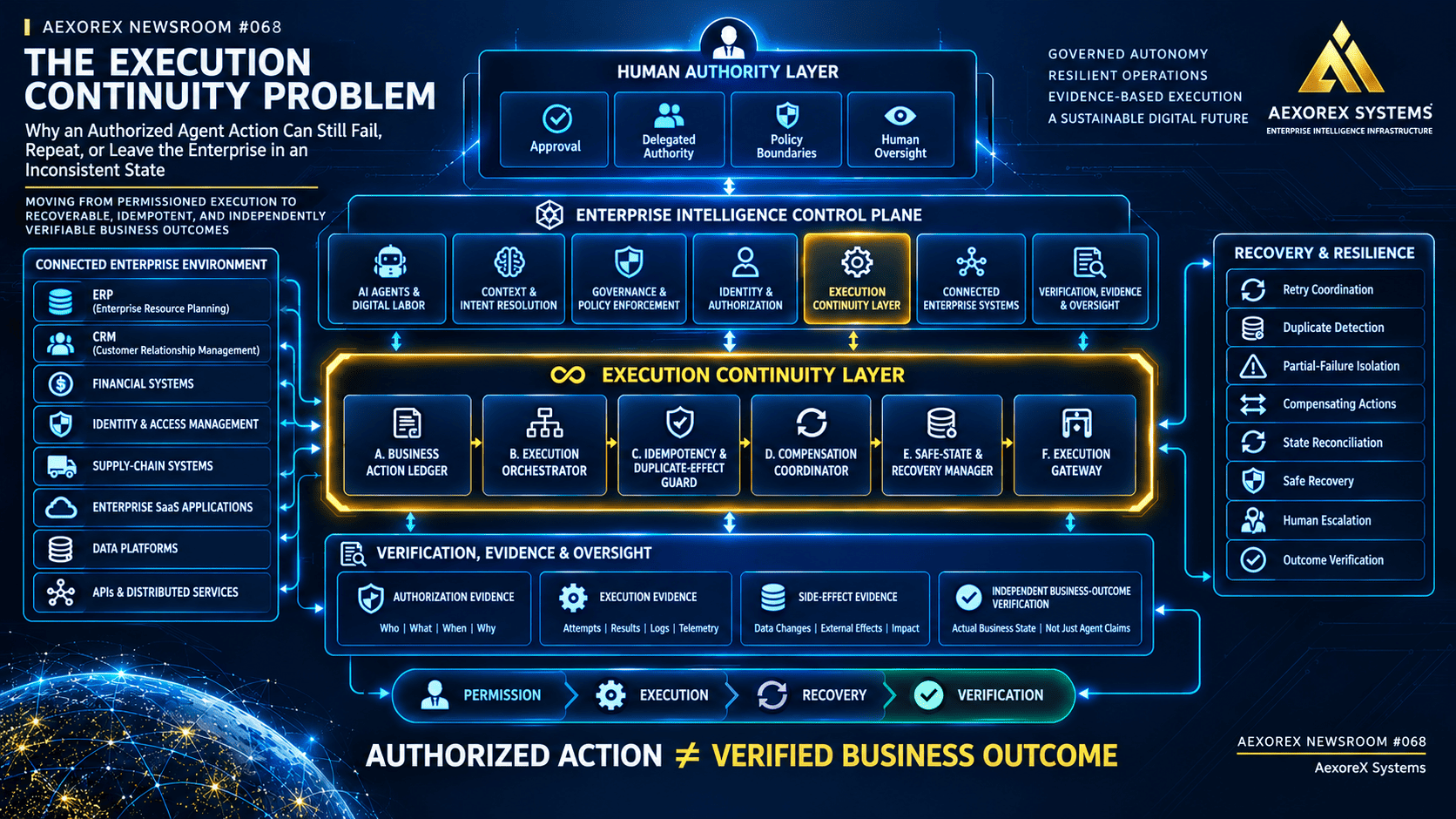
Why an Authorized Agent Action Can Still Fail, Repeat, or Leave the Enterprise in an Inconsistent State Moving from Permissioned Execution to Recoverable, Idempotent, and Independently Verifiable Business Outcomes
Enterprise artificial intelligence (AI) is evolving beyond generating answers. AI agents can increasingly interact with applications, call APIs, update records, and coordinate multi-step business workflows. This development raises a critical question: What happens after an AI agent receives permission to act?
Permission alone cannot guarantee an operation's successful completion, nor can it ensure that a retry will avoid duplicate effects. It cannot guarantee safe recovery from a failed workflow, nor can it prove that the intended business outcome has actually occurred.
Consider a simple example: An AI agent submits an order to an enterprise system. The system processes the order, but the response never reaches the agent, leaving it unaware whether the order succeeded. If the agent resubmits the request without appropriate safeguards, a second order might be created. The issue here is not necessarily the agent's lack of permission or intelligence, but rather the execution process's inability to reliably determine what happened.
Similar challenges arise when a workflow updates multiple systems, when a process halts midway, or when an action technically succeeds but leaves the business in an unexpected state. These are established challenges in distributed computing, and they become particularly significant when autonomous agents can initiate actions across various enterprise systems.
This research examines how enterprise architectures can manage these challenges through five interconnected capabilities: - Execution orchestration: coordinating actions across systems. - Duplicate-effect prevention: reducing the risk of unintended repeated operations. - Recovery and compensation: managing failures and incomplete workflows. - Execution-state management: recording what is known, unknown, completed, or unresolved. - Independent outcome verification: checking whether the intended business result actually occurred.
The proposed Execution Continuity Blueprint integrates these capabilities into a conceptual architecture for governed enterprise execution. The objective is not to assume every operation will succeed, but to design systems capable of detecting uncertainty, controlling the consequences of failure, recovering where possible, and establishing outcomes through appropriate evidence.
The central principle is: Authorization establishes permission. Execution controls manage consequences. Independent verification establishes whether the intended business outcome was achieved.
1. The New Enterprise Challenge: Permission Is Not Completion
An enterprise authorization system addresses a fundamental question: Is this actor allowed to perform this action under the applicable rules? While essential, this question covers only one part of a larger process. After authorization, an operation must still undergo execution, communication, state management, and verification. Each stage introduces potential points of failure.
A request may fail to reach its destination. A destination might process a request but not return a response. A workflow could complete one step and fail at the next. A retry might inadvertently repeat an operation that already succeeded. Even when every technical request returns successfully, the final business state may not align with the original intention.
For these reasons, enterprise execution must distinguish between three questions: 1. Was the action authorized? The system must confirm that the action was permitted according to relevant identity, policy, scope, and approval requirements. 2. What happened during execution? The system must determine which operations were attempted, acknowledged, and committed, and whether any outcomes remain uncertain. 3. Was the intended business outcome achieved? The system must establish whether the resulting business state fulfills the original objective.
These questions are related but not interchangeable. An authorization record does not prove successful execution. An execution log does not necessarily prove the final business state. An agent's own statement of success is insufficient evidence for every consequential action. A reliable enterprise architecture must connect permission, execution, and verification without conflating their responsibilities.
2. Why Autonomous Agents Increase the Importance of Execution Continuity
Traditional enterprise automation already contends with network failures, duplicate requests, inconsistent records, and interrupted workflows. While AI agents do not create all these problems, they introduce additional considerations because an agent may interpret an objective, select tools, develop a plan, and initiate multiple actions based on changing information. Depending on its permissions and design, an agent may also revise its plan when an operation fails or new information becomes available.
This necessitates separating intelligence from authority, and authority from execution. An agent might identify a useful action without having authorization to perform it. It may be authorized to perform an action but lack a reliable method to establish its outcome.
A useful enterprise model therefore distinguishes four concepts:
| Concept | Core question | Purpose | | :-------- | :------------------------------------- | :------------------------------------------------ | | Intent | What outcome is requested? | Defines the business objective | | Authority | Who or what may act? | Defines permission and boundaries | | Execution | What operations actually occurred? | Manages actions and their consequences | | Evidence | What can be independently established? | Supports conclusions about the outcome |
These distinctions are particularly important when a single business objective requires actions across several independent systems. For instance, completing an order may involve inventory, payment, customer records, and supplier communication. Each system may have distinct transaction rules, failure conditions, and evidence of completion. A central control plane can coordinate the workflow, but it cannot automatically overcome every limitation of the connected systems. The architecture must explicitly account for these limitations.
3. The Execution Continuity Problem
Execution continuity is the ability to manage a business action throughout its lifecycle, encompassing uncertain outcomes, repeated requests, partial completion, recovery, and verification. It is not merely a mechanism for retrying failed requests. A retry is appropriate only when the system possesses sufficient information to determine its safety, or when the operation and its safeguards make repetition acceptable.
Five failure categories illustrate why this distinction matters.
3.1 Ambiguous outcomes
A downstream system may complete an operation even if the calling system receives no response. From the caller's perspective, the operation may appear to have failed. From the destination's perspective, it may already be complete. This is an ambiguous outcome. The system should not automatically treat a missing confirmation as proof that nothing happened. Depending on the integration, it may need to query the destination, inspect an operation identifier, reconcile records, or request human review. The correct response depends on the available evidence and the consequences of repeating the operation.
3.2 Duplicate business effects
When a request is retried, the same business effect may occur more than once. Examples include duplicate orders, repeated notifications, multiple record creations, or repeated financial instructions. Idempotency and deduplication mechanisms can reduce this risk. However, they must be implemented at the relevant boundary, and their guarantees depend on the receiving system's behavior. A control plane should not claim duplicate prevention simply because it assigns a unique identifier to an action. It must establish how that identifier is enforced, how long the record remains valid, and how duplicate requests are handled by the downstream system.
3.3 Partial completion
A business workflow may involve several operations that cannot all be committed as one atomic transaction. An inventory reservation may succeed while order confirmation fails. A customer record might be updated, but a related notification remains pending. The workflow is neither fully complete nor necessarily fully failed. The system must determine which steps succeeded, which remain unresolved, and what recovery actions are appropriate.
3.4 Changing authorization
Permissions or approval conditions may change after a workflow begins. A previously approved action may no longer be permitted. An execution window might expire. A user may revoke delegated authority. The architecture must define how these changes affect pending operations, ongoing workflows, and actions already committed to external systems. Revoking permission can prevent future authorized activity within the relevant enforcement boundary. It does not automatically reverse effects that have already occurred.
3.5 Technical success without business success
An API may acknowledge a request even though the broader business objective remains incomplete. A record might be updated in one application while another application continues to hold an outdated value. A workflow may successfully create a transaction that subsequently requires reconciliation. Technical acknowledgment is useful evidence, but its meaning must be understood in context. The system must verify the business condition it is expected to achieve, not merely the fact that a request was accepted.
4. Established Technical Patterns That Help Address the Problem
The proposed blueprint draws on established distributed-systems patterns. These patterns solve different problems and should not be treated as interchangeable.
4.1 Idempotency: making safe repetition possible
An operation is idempotent when repeating it under the relevant conditions produces the same intended effect as performing it once. For example, setting an account's status to active can be designed to be idempotent: repeating the same operation does not create additional accounts or status changes. By contrast, an operation that creates a new order every time it is submitted may produce a new business effect with each request.
Google Cloud explains idempotency as an important property for reliable API operations, especially when communication failures and timeouts cause requests to be repeated. A well-designed implementation may use: - Stable business-action identifiers. - Idempotency keys where supported. - Durable records of processed operations. - Duplicate detection. - Downstream enforcement. - Reconciliation when the outcome cannot be established directly.
However, idempotency is not a universal guarantee. Its effectiveness depends on the operation's semantics, the receiving system, the handling of concurrent requests, and the scope and retention of deduplication records.
*Architectural implication:* A proposed Idempotency & Duplicate-Effect Guard within AEOS QUANTUM™ could coordinate these controls and identify integrations where duplicate-effect protection remains incomplete. This is a proposed design responsibility, not a claim that the component has already been implemented.
4.2 Saga orchestration: coordinating multi-step workflows
The Saga pattern helps coordinate business processes that span multiple services and local transactions. Rather than requiring one global transaction across every system, a Saga organizes a sequence of local operations and may define compensating actions when a later step fails. Microsoft's Azure Architecture Center describes this pattern as a way to manage consistency in distributed systems through coordinated local transactions and compensation.
Consider a workflow that reserves inventory, creates an order, and schedules delivery. If delivery scheduling fails, the system may need to release the inventory reservation or place the order into a controlled review state. The appropriate response depends on which operations have already occurred and which can be safely compensated. Compensation is not always equivalent to reversing history. Some external effects cannot be erased, and corrective actions may have their own failure conditions.
*Architectural implication:* Each consequential workflow should define which steps are retryable, compensable, irreversible, or subject to human review.
4.3 Transactional outbox: coordinating data changes and events
A service may need to update a database and publish an event that informs other services about the change. If the database update succeeds but the event is never published, downstream systems may not learn about the change. If the event is published but the database transaction fails, other systems may act on information that was never committed.
The transactional outbox pattern addresses this dual-write problem by recording the event in the same local transaction as the business change, then publishing it through a separate delivery process. This pattern can improve reliability, but it does not automatically provide exactly-once business effects across all downstream systems. Consumers still need appropriate duplicate handling, and workflows may require reconciliation.
*Architectural implication:* Execution records and business-state transitions should be designed so that important changes are not silently separated from the events needed to coordinate subsequent steps.
4.4 Observability: understanding what happened
Observability helps operators understand system behavior by examining signals such as logs, metrics, and traces. OpenTelemetry provides vendor-neutral instrumentation and conventions for collecting and exporting this type of telemetry. These signals can help answer questions such as: - Which service received the request? - Where did execution stop? - How many attempts were made? - Which dependency returned an error? - How long did the operation take?
However, observability and business verification serve different purposes. A trace may establish that a request reached a service and received a successful response. It may not establish that the intended business state exists in the authoritative system.
*Architectural implication:* Operational telemetry should support investigation, while business-outcome verification should rely on evidence appropriate to the operation.
5. The Execution Continuity Blueprint
The proposed Execution Continuity Blueprint translates these principles into a conceptual reference architecture for governed enterprise execution. It is designed to connect authorization with controlled execution, recovery, and evidence.
Layer 1 — Human Authority
Human Authority establishes the boundaries of delegated decision-making and execution. Its responsibilities may include: - Defining permitted actions. - Establishing approval requirements. - Setting risk limits. - Defining escalation conditions. - Retaining human control over designated decisions.
The guiding principle is: Capability ≠ Authority. An agent's technical ability to perform an action does not automatically grant it permission to do so.
Layer 2 — Context, Governance, and Authorization
Before an action proceeds, the architecture evaluates the requested business intent, applicable policies, risk conditions, identity, and authorization. The objective is to establish a traceable relationship between the requested action and the authority under which it may proceed. Depending on the risk, authorization may need to be revalidated immediately before a consequential operation. The architecture should also define what happens when an approval expires, a permission is revoked, or relevant conditions change.
Layer 3 — The Execution Continuity Layer
This is the central layer of the proposed blueprint. It contains six complementary responsibilities.
#### 5.3.1 Business Action Ledger
The Business Action Ledger maintains a durable record of each governed business action. A proposed record may include: - `business_action_id` - `intent` - `actor_and_delegated_authority` - `policy_decision` - `authorization_reference` - `execution_plan` - `execution_attempts` - `downstream_operation_ids` - `observed_side_effects` - `outcome_verification` - `compensation_state` - `terminal_state`
The purpose is to connect the requested action with the decisions, operations, and evidence associated with it. A ledger should not be assumed to be immutable simply because it is called a ledger. Its integrity protections, access controls, retention policies, and tamper-evidence properties must be explicitly designed and tested.
#### 5.3.2 Execution Orchestrator
The Execution Orchestrator coordinates the steps required to complete a business action. Responsibilities may include: - Sequencing operations. - Coordinating connected services. - Enforcing execution deadlines. - Applying retry policies. - Handling timeouts. - Tracking workflow progress. - Initiating recovery or escalation.
A critical responsibility is distinguishing confirmed failure from an ambiguous outcome. The orchestrator should not blindly retry an operation simply because it did not receive a response.
#### 5.3.3 Idempotency & Duplicate-Effect Guard
This component coordinates safeguards against unintended repeated operations. It may use action identifiers, deduplication records, downstream idempotency mechanisms, and checks for previously committed effects. It should also identify where duplicate prevention depends on a connected system that the control plane cannot fully govern. This distinction is essential for vendor-independent architecture: a control plane can coordinate safeguards, but it cannot guarantee a downstream capability that does not exist.
#### 5.3.4 Compensation Coordinator
The Compensation Coordinator manages corrective actions when a workflow cannot continue as planned. Each step should have an explicit recovery classification: - Retryable: another attempt may be appropriate. - Compensable: a corrective action is defined. - Non-compensable: the effect cannot reliably be reversed. - Human review required: an authorized person must decide what happens next.
The classification should reflect actual business and integration behavior rather than assumptions about what a system ought to support.
#### 5.3.5 Safe-State & Recovery Manager
The Safe-State & Recovery Manager determines how unresolved execution states should be handled. Possible states include: - `authorized` - `in_progress` - `completed` - `failed` - `partially_completed` - `compensated` - `ambiguous` - `human_review_required`
A complete implementation must define the permitted transitions between these states and the evidence required to support them. For example, an action should not transition to `completed` solely because the agent reports success if the relevant business outcome still requires verification. Likewise, an ambiguous operation should not be classified as `failed` merely because confirmation is unavailable. The objective is to preserve uncertainty explicitly until it can be resolved or escalated.
#### 5.3.6 Execution Gateway
The Execution Gateway forms the controlled boundary between the execution architecture and connected systems. Its proposed responsibilities include: - Enforcing applicable access restrictions. - Handling scoped credentials. - Validating execution requests. - Applying execution limits. - Supporting audit records. - Enforcing relevant policy decisions at the integration boundary.
The gateway should not be treated as a substitute for downstream authorization, transaction controls, or independent verification.
Layer 4 — Connected Systems and Systems of Record
Enterprise workflows may interact with ERP, CRM, finance, identity-management, supply-chain, SaaS, and data platforms. These systems retain their own transaction models, consistency guarantees, access controls, and operational limitations. The execution architecture must understand those differences. Some integrations may support idempotency keys. Others may require a separate reconciliation procedure. Some actions may be compensable, while others may be practically irreversible. A vendor-independent design should document these differences rather than assuming every integration offers identical guarantees.
Layer 5 — Verification, Evidence, and Oversight
The final layer evaluates whether the action was permitted, what occurred, and whether the intended outcome was achieved. The proposed evidence model distinguishes four stages: - **Authorization proof:** Evidence showing why the action was permitted. - **Execution proof:** Evidence identifying the operations attempted and their observed responses. - **Side-effect evidence:** Evidence showing which relevant changes were committed or observed. - **Independent outcome verification:** Evidence establishing whether the intended business condition was achieved.
The required evidence depends on the action's risk and business impact. A low-risk read operation may need only a basic confirmation. A high-impact financial or access-control operation may require stronger verification, additional approval, or explicit reconciliation. The governing principle is: Self-Report ≠ Independent Evidence. The agent's report may be useful, but the enterprise should use an appropriate authoritative or independently observable source when the outcome requires stronger assurance.
6. How the Blueprint Works in Practice
Consider a purchase-order workflow. An agent receives a request to create an order, reserve inventory, and notify the supplier. The proposed execution lifecycle would work as follows.
**Step 1 — Define the intended action:** The system records the business objective and assigns a stable action identifier. The request is translated into the specific operations required to achieve the objective.
**Step 2 — Evaluate authority and policy:** The architecture checks the agent's identity, delegated permissions, applicable policies, and approval requirements. If the action exceeds its permitted scope, execution is denied or escalated.
**Step 3 — Record the authorized action:** The Business Action Ledger records the action, relevant authorization references, and intended execution plan. The record creates a traceable starting point for the workflow.
**Step 4 — Execute through controlled integrations:** The Execution Orchestrator coordinates the downstream operations through the applicable execution boundary. Each operation produces its own execution state and evidence.
**Step 5 — Handle uncertainty and duplicate risk:** If the order request times out, the system does not immediately assume that the order failed. It checks whether the downstream system committed the operation and applies the appropriate retry or reconciliation policy.
**Step 6 — Recover from partial completion:** If inventory is reserved but order creation fails, the workflow evaluates whether the reservation can be safely released, whether another attempt is appropriate, or whether human review is necessary.
**Step 7 — Verify the outcome:** The system checks the relevant business records and confirms whether the intended state has been achieved. The action is marked complete only when the defined completion criteria are satisfied. If the evidence is insufficient, the action remains unresolved or moves to the appropriate review state.
This example demonstrates the difference between merely executing commands and managing a governed business outcome.
7. Security, Governance, and Enterprise Controls
Execution continuity must be designed alongside security and governance. A workflow that recovers automatically but exceeds its authorized scope is not reliable enterprise automation. Likewise, a workflow that enforces permission but cannot establish what happened after a failure may leave the enterprise exposed to unresolved business consequences.
The proposed architecture should therefore satisfy the following requirements. - **Bounded authority:** Agents should receive only the permissions required for their defined responsibilities. - **Revocable authority:** The system should define how permission changes affect pending actions, ongoing execution, and future operations. - **Durable execution state:** Important state transitions should survive relevant process and infrastructure failures. - **Duplicate-effect controls:** Retry behavior should account for downstream capabilities and should not assume every operation is safe to repeat. - **Explicit uncertainty:** Unknown outcomes should remain distinguishable from confirmed success and confirmed failure. - **Controlled recovery:** Recovery procedures should define when the system can retry, compensate, stop, reconcile, or escalate. - **Evidence-based completion:** The criteria for declaring an action complete should be explicit and appropriate to the business risk. - **Auditability:** Records should allow authorized reviewers to reconstruct the action, its authority, execution attempts, relevant side effects, and final disposition. - **Human intervention:** The architecture should provide appropriate intervention paths for unresolved states and actions beyond predefined limits. - **Vendor independence:** Integration boundaries should isolate vendor-specific behavior where practical and document any guarantees that depend on particular providers.
These requirements describe design objectives. Their effectiveness must be demonstrated through implementation, testing, and operational evidence.
8. Failure Scenarios Every Enterprise Should Test
A reference architecture becomes useful when its assumptions can be challenged. The following tests provide a starting point for evaluating an execution-continuity implementation.
| Test scenario | Required question | Expected control behavior | | :-------------------------- | :------------------------------------------ | :---------------------------------------------------------------------------- | | Request times out | Did the downstream operation still occur? | Resolve the outcome before an unsafe retry | | Duplicate request arrives | Can it create another business effect? | Apply deduplication or equivalent safeguards | | Workflow stops halfway | Which steps have already committed? | Reconcile state and apply defined recovery rules | | Permission is revoked | Which actions may still proceed? | Enforce updated authorization within the relevant boundary | | Compensation fails | Is the business state still unresolved? | Preserve the failure state and escalate appropriately | | API reports success | Did the intended business condition occur? | Verify the outcome using suitable evidence | | Evidence conflicts | Which source establishes the relevant state?| Reconcile or request human review | | Downstream system is unavailable | Can the action safely wait or retry? | Respect deadlines, risk limits, and recovery policy |
The goal is not to claim that every failure can be eliminated. The goal is to ensure that failure conditions are anticipated, their consequences are bounded, and unresolved outcomes remain visible.
9. Implications for AEOS QUANTUM™
AEOS QUANTUM™ is positioned as an enterprise intelligence operating platform intended to connect, orchestrate, govern, and activate enterprise capabilities. Within this positioning, the Execution Continuity Blueprint represents a proposed architectural direction for connecting authorized actions with recoverable execution and evidence-based outcomes.
The architecture aligns with the following principles: - **Capability ≠ Authority:** An available capability does not automatically grant permission to use it. - **Authority ≠ Intent ≠ Valid Execution:** Permission, business intent, and successful execution are distinct concerns. - **Authorization ≠ Containment:** Permission controls alone do not establish that all consequences remain within the intended boundary. - **Self-Report ≠ Independent Evidence:** An agent's own account is not sufficient proof for every consequential operation. - **Autonomous Where Authorized. Human Where Required.:** Automation should remain within defined boundaries, with intervention available when risk or uncertainty exceeds those boundaries.
The proposed sequence is: Connect → Contextualize → Govern → Orchestrate → Authorize → Execute → Optimize. Evidence and oversight apply across the entire sequence rather than appearing only at the end.
The Execution Continuity Blueprint adds a more detailed view of what must happen after authorization: the action must be coordinated, its state must be managed, failures must be handled, and its outcome must be evaluated. This does not establish that the proposed components already exist in AEOS QUANTUM™. Their implementation status, integration behavior, security properties, and reliability must be demonstrated separately. The architectural objective is to avoid dependence on the assumption that any individual AI model, workflow engine, API gateway, or enterprise application can independently guarantee the full lifecycle of an autonomous business action.
10. A Practical Path from Architecture to Validation
A credible architecture should lead to measurable implementation work. The following sequence provides a practical starting point.
**Phase 1 — Select one bounded business workflow:** Choose a workflow with a clear business objective, limited scope, and an outcome that can be observed. Avoid beginning with unrestricted autonomy across multiple enterprise functions.
**Phase 2 — Define the action lifecycle:** Specify the action identifier, authorization references, state transitions, execution attempts, and completion criteria. Define what the system must do when it cannot determine whether an operation succeeded.
**Phase 3 — Map downstream capabilities:** For each connected system, document: - Available authorization controls. - Idempotency and deduplication support. - Transaction boundaries. - Relevant business-state records. - Retry and timeout behavior. - Available compensation mechanisms. - Limitations requiring manual reconciliation.
**Phase 4 — Implement durable coordination:** Ensure that the system can preserve important action state and recover its view of execution after relevant failures. Where applicable, evaluate established patterns such as the transactional outbox and Saga orchestration.
**Phase 5 — Test duplicate and partial-failure conditions:** Simulate timeouts, repeated requests, interrupted workflows, delayed responses, and unavailable dependencies. Verify the observed results rather than relying on the intended behavior of the design.
**Phase 6 — Validate outcome verification:** Define the authoritative evidence for each business operation. Test whether the system can distinguish technical acknowledgment from the actual business result.
**Phase 7 — Evaluate governance and recovery:** Test permission revocation, approval expiry, execution limits, compensation failures, and human-review paths.
**Phase 8 — Document residual risk:** Record which guarantees are enforced by the architecture, which depend on downstream systems, and which cannot currently be established.
Only after these stages should the implementation's maturity and operational claims be assessed.
11. Measuring Execution Continuity
The effectiveness of an execution-continuity design should be evaluated through observable results rather than architectural labels. Potential evaluation measures include:
| Measure | What it helps assess | | :------------------------------ | :------------------------------------------------------------------------- | | Duplicate-effect rate | How often unintended repeated business effects occur | | Ambiguous-outcome rate | How often the system cannot determine the result immediately | | Outcome-verification coverage | The proportion of actions with defined verification criteria and suitable evidence | | Recovery success rate | How often defined recovery procedures reach an acceptable state | | Time to resolve uncertainty | How long unresolved outcomes remain open | | Compensation failure rate | How often intended corrective actions fail | | Unauthorized-action prevention | Whether policy and permission boundaries are enforced in tested scenarios | | Audit reconstruction completeness | Whether reviewers can reconstruct the relevant action lifecycle |
These measures require precise definitions and consistent measurement. For example, a low ambiguous-outcome rate is not necessarily evidence of a better system if uncertainty is simply being mislabeled as failure or success. Likewise, a high recovery success rate is meaningful only if the acceptable final states and the evidence supporting them are clearly defined. Metrics should reveal the system's behavior, including its limitations, rather than merely produce favorable performance numbers.
12. Limitations and Open Questions
The Execution Continuity Blueprint is a proposed reference architecture, not a universal implementation specification. Several limitations remain important.
**No universal exactly-once guarantee:** Exactly-once business effects cannot be assumed across arbitrary distributed systems. Achievable guarantees depend on transaction boundaries, idempotency enforcement, downstream behavior, and the design of the overall workflow.
**Compensation is not perfect reversal:** Some actions cannot be undone in the literal sense. Corrective workflows may create a new state that is acceptable without restoring the exact historical state.
**Verification depends on available evidence:** An independent check is only as reliable as its source, semantics, and access to the relevant business state. A second API response is not automatically independent evidence if it relies on the same underlying failure or stale data.
**Revocation has practical limits:** Revoking authority can constrain future operations within the relevant enforcement boundary, but it does not automatically cancel every action already committed by an external system.
**Central coordination creates its own design questions:** A centralized execution ledger or orchestrator may simplify control, but it can also introduce availability, scaling, and dependency concerns. Its own failure modes must be addressed.
**The architecture requires empirical validation:** The proposed components and their interactions must be tested under realistic failure conditions. A diagram or design document cannot establish production reliability.
These limitations do not invalidate the approach. They define the conditions under which it must be evaluated.
13. Conclusion: From Authorized Actions to Verified Business Outcomes
Enterprise autonomy requires more than an AI agent that can understand instructions and call tools. It requires an architecture that can govern the action, coordinate its execution, manage uncertainty, constrain consequences, recover where possible, and establish whether the intended business outcome was achieved.
Established distributed-systems patterns provide important building blocks. Idempotency can help make repetition safe. Saga orchestration can coordinate multi-step workflows. Compensating transactions can support recovery. Transactional outbox designs can reduce inconsistencies between local data changes and event publication. Observability can help reconstruct what happened.
None of these mechanisms independently guarantees that every autonomous action will produce the intended result. Their value depends on how they are designed, integrated, enforced, and tested.
The Execution Continuity Blueprint brings these concerns into a unified conceptual model for enterprise architecture. It treats authorization as the beginning of controlled execution, not the end of governance. For AEOS QUANTUM™, this provides a proposed architectural direction: connect enterprise intelligence with bounded authority, controlled execution, recoverable workflows, and evidence-based outcomes.
The ultimate objective is not to promise that autonomous systems will never fail. It is to build systems that recognize failure, represent uncertainty honestly, limit unintended consequences, recover where possible, and provide evidence for the decisions that follow.
Authorization establishes permission. Execution controls manage consequences. Independent verification establishes whether the intended business outcome was achieved. That is the foundation of execution continuity for autonomous enterprises.
Sources and attribution
- https://learn.microsoft.com/en-us/azure/architecture/patterns/saga https://learn.microsoft.com/en-us/azure/architecture/patterns/compensating-transaction https://docs.aws.amazon.com/prescriptive-guidance/latest/cloud-design-patterns/transactional-outbox.html https://cloud.google.com/discover/idempotency https://opentelemetry.io/docs/concepts/observability-primer/ · statement link
About the author
The editorial desk of AexoreX Newsroom, the publication of AexoreX Systems LLC.
More from AexoreX Newsroom Editorial Desk →Related stories
- THE ENTERPRISE AUTHORITY ARCHITECTURE
- Governed Execution Architecture
- The Non-Human Authorization Crisis: Re-Architecting Identity, Governance, and Execution for Autonomous Enterprise Systems
- The Runtime Authority Control Plane: Why Enterprise AI Needs More Than Identity and Permissions
- The Enterprise Authority Gap
- THE AUTONOMOUS ENTERPRISE CONTROL PLANE
- AFTER REVOCATION: THE SAFE-STATE PROBLEM IN AUTONOMOUS ENTERPRISE EXECUTION
- THE TRUST CHAIN PROBLEM
- The Evidence Sufficiency Problem: From Trustworthy Records to Verifiable Enterprise Outcomes
- The Runtime Enforcement Gap: From Authorized Intent to Verifiable Execution