
The Multi-Digital Labor Control Plane
Governing Digital Labor as a Service Across the Autonomous Enterprise
Enterprises need a Multi-Digital Labor Control Plane to govern a growing digital workforce that performs defined operational work across diverse systems.
Opinion · AI-assisted, human edited
Executive Thesis
The enterprise is transitioning into a new era of digital work. For decades, software primarily assisted human work. Automation then enabled software to execute predefined processes. Artificial intelligence (AI) further expanded software's ability to interpret information, generate content, reason across contexts, and support decisions.
The next transition is more significant. Increasingly capable intelligent systems can perform defined operational work across enterprise environments. This raises a new question for organizations: How does an enterprise govern a growing digital workforce that can act across its systems?
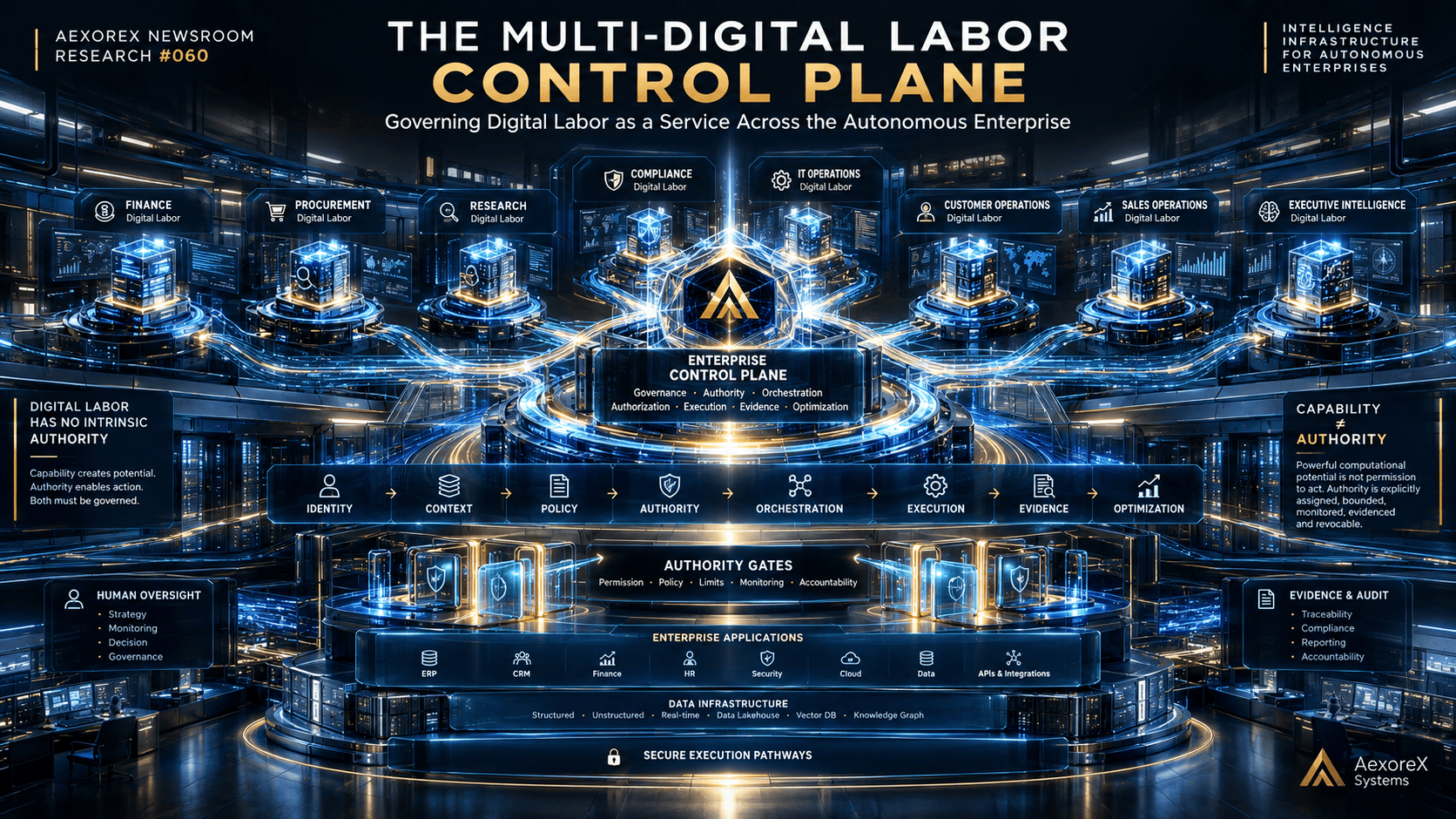
The answer is not merely deploying more AI agents. It requires an operating architecture for Digital Labor. This is the strategic premise behind Digital Labor as a Service (LaaS) and, at an enterprise scale, Multi-Digital Labor as a Service. The emerging requirement is a Multi-Digital Labor Control Plane: an architectural layer designed to govern identity, context, policy, authority, orchestration, execution, evidence, and optimization across distributed Digital Labor units.
01 — Beyond the Agent
The term "AI agent" is central to the current generation of enterprise AI. An agent can reason, retrieve information, use tools, invoke APIs, coordinate tasks, and in some environments, execute actions. However, enterprises do not organize themselves around agents; they organize around work.
Enterprise work involves responsibilities, processes, objectives, risk, authority, dependencies, controls, accountability, and measurable outcomes. This distinction highlights an important architectural separation: - An AI agent is primarily a technical abstraction. - Digital Labor is an operational abstraction.
An agent may be one mechanism for implementing Digital Labor. A Digital Labor unit might combine models, agents, workflows, rules, memory, APIs, enterprise applications, and human escalation. Therefore, AI agents describe a mechanism of intelligent execution, while Digital Labor describes an operational unit of enterprise work.
This distinction shifts the enterprise conversation from "how intelligent is the system?" to "what work is it responsible for, and under what authority may it perform that work?"
02 — From Intelligence to Digital Work
The evolution of digital capabilities can be understood as a progression: - **Software:** Assists human work. - **Automation:** Executes predefined work. - **Artificial Intelligence:** Augments analysis, generation, and decision support. - **AI Agents:** Combine reasoning, tools, context, and action. - **Digital Labor:** Performs defined enterprise work within operational boundaries. - **Multi-Digital Labor:** Coordinates multiple Digital Labor units across enterprise functions. - **Autonomous Enterprise:** Continuously coordinates human and digital capacity around enterprise objectives.
This model does not claim that every AI system should be treated as labor. Instead, it is an architectural framework for systems entrusted with recurring, measurable, and governed operational work.
03 — Digital Labor as a Service
Digital Labor as a Service (LaaS) offers a service-oriented model for delivering governed digital work capacity. Rather than viewing intelligent automation solely as a software feature, an enterprise can provision Digital Labor based on several criteria: - **Role:** What function does it perform? - **Purpose:** Why does the Digital Labor exist? - **Capability:** What can it technically do? - **Context:** What information can it use? - **Work Scope:** What work is within its responsibility? - **Authority:** What actions may it legitimately perform? - **Policy:** Which organizational rules govern it? - **Approval:** Which actions require additional authorization? - **Escalation:** When must the matter return to human control? - **Evidence:** What records demonstrate what happened? - **Outcome:** What measurable result was produced?
This creates a fundamental shift: the enterprise is no longer provisioning intelligence alone; it is provisioning governed capacity to perform work.
04 — From Multi-Agent to Multi-Digital Labor
While the progression in AI is often described as "One Agent → Multi-Agent," for enterprise architecture, a more useful abstraction is "One Digital Labor Unit → Multi-Digital Labor Workforce."
A large enterprise may operate specialized Digital Labor across various functions: - **Research:** Intelligence gathering, synthesis, monitoring, and analysis. - **Finance:** Defined financial analysis and authorized financial operations. - **Procurement:** Sourcing, evaluation, workflow preparation, and permitted procurement execution. - **Customer Operations:** Defined customer-service and operational workflows. - **Compliance:** Monitoring, evidence collection, control testing, and escalation. - **IT Operations:** Authorized operational procedures and infrastructure workflows. - **Sales Operations:** Defined revenue and customer-process support. - **Executive Intelligence:** Decision preparation, enterprise intelligence, and strategic monitoring.
These Digital Labor units can have radically different capabilities and risk profiles, meaning they cannot simply share unrestricted access. They require a common governance architecture.
05 — The Control Plane
A Multi-Digital Labor environment necessitates a control plane capable of addressing fundamental operational questions: - **Identity:** Who or what is acting? - **Context:** What does it know about the current situation? - **Policy:** What rules apply? - **Authority:** What is it actually permitted to do? - **Risk:** What is the potential consequence of the action? - **Approval:** Does this action require additional authorization? - **Execution:** How is the authorized action performed? - **Evidence:** What happened, under what conditions, and with what result? - **Optimization:** What should change based on the outcome?
The control plane, therefore, transcends mere workflow coordination. It becomes the mechanism through which autonomous capability is transformed into governed enterprise execution.
06 — Capability ≠ Authority
A foundational principle of the AexoreX architecture is "Capability ≠ Authority." A Digital Labor unit may be technically capable of performing an action without being authorized to perform it.
- A system may be able to create a payment instruction, but that does not mean it should be allowed to approve or release the payment.
- A Digital Labor unit may be able to modify a customer record, but that does not mean it should have unrestricted authority over customer data.
- A Digital Labor unit may be able to execute an infrastructure command, but that does not mean it should have unrestricted operational control.
Therefore, technical capability must never be treated as organizational authority. Digital Labor has no intrinsic authority; authority must be deliberately assigned, scoped, governed, enforced, monitored, evidenced, and revocable.
07 — The Digital Labor Authority Model
AEOS QUANTUM conceptualizes graduated Digital Labor authority: - **D1 — Recommend:** Analyze, prepare, suggest, and escalate. - **D2 — Decide:** Make decisions within defined boundaries. - **D3 — Decide & Execute:** Make permitted decisions and execute the resulting actions. - **D4 — Control & Escalation:** Operate a defined operational domain under stronger controls, monitoring, and escalation.
The objective is not maximum autonomy but appropriate autonomy. Therefore, autonomy should be earned through governance, not assumed through capability.
08 — The Multi-Digital Labor Control Architecture
The emerging architecture can be represented as:
**HUMAN WORKFORCE** - Strategy - Judgment - Accountability - Exception handling
**↓**
**ENTERPRISE GOVERNANCE** - Policy - Risk - Authority - Controls - Oversight
**↓**
**AEOS QUANTUM™** - Enterprise Intelligence - Context - Governance - Orchestration - Authorization - Execution - Evidence - Optimization
**↓**
**MULTI-DIGITAL LABOR** - Research - Finance - Procurement - Operations - Compliance - IT - Sales - Executive Intelligence - Enterprise-specific Digital Labor
**↓**
**ENTERPRISE SYSTEMS** - ERP - CRM - HRIS - Finance - Data Platforms - Communication Systems - Operational Applications - Custom Systems
**↓**
**EXTERNAL INFRASTRUCTURE** - AI Models - Cloud Infrastructure - APIs - Services - Partners
This architecture is deliberately not designed to replace the enterprise stack. Instead, AEOS connects, orchestrates, governs, and activates the existing enterprise stack.
09 — Connect to Optimize
AEOS QUANTUM organizes autonomous enterprise operations through seven core movements: 1. **CONNECT:** Connect enterprise systems, data, applications, services, and capabilities. 2. **CONTEXTUALIZE:** Establish the context required to understand the work. 3. **GOVERN:** Apply policies, controls, risk boundaries, and operating rules. 4. **ORCHESTRATE:** Coordinate humans, Digital Labor, workflows, systems, and dependencies. 5. **AUTHORIZE:** Determine whether a specific action is permitted under applicable authority and conditions. 6. **EXECUTE:** Perform the authorized action through connected enterprise systems. 7. **OPTIMIZE:** Use evidence, outcomes, and operational intelligence to continuously improve execution.
Across every movement, **EVIDENCE** is a cross-cutting property of governed execution, not a separate stage. A meaningful autonomous action should provide answers to: - What happened? - Why did it happen? - Who or what initiated it? - Under what authority? - Under which policy? - Against which system? - What was the result? - What should happen next?
10 — Why Multi-Digital Labor Changes the Architecture
Enterprise environments are inherently heterogeneous. Different functions use different applications, systems expose different capabilities, jurisdictions impose different requirements, and workflows carry varying levels of risk. Consequently, different Digital Labor units require distinct operating boundaries.
- A research Digital Labor unit should not automatically inherit payment authority.
- A customer-operations Digital Labor unit should not automatically inherit procurement authority.
- An IT Digital Labor unit should not automatically inherit executive authority.
This leads to another foundational principle: Authority must be contextual, purpose-bound, and proportional to the action.
11 — Digital Labor Orchestration
Multiple Digital Labor units must be able to cooperate without becoming an uncontrolled network of autonomous actors. Consider a procurement process involving multiple units: - Research Digital Labor - Procurement Digital Labor - Finance Digital Labor - Compliance Digital Labor - Human Approval - Enterprise Execution
Each unit may perform a different part of the process. The enterprise, therefore, needs orchestration across sequencing, dependencies, context, handoffs, authority, approvals, exceptions, escalation, execution, evidence, and outcomes. The objective is not simply to coordinate agents, but to coordinate enterprise work.
12 — Vendor Independence by Design™
Digital Labor should not be synonymous with a particular AI model, vendor, or agent framework. One Digital Labor workload may benefit from one intelligence provider, while another may require a different one. Some workloads might combine multiple models, while others rely heavily on deterministic rules, enterprise applications, APIs, memory, or human judgment.
Therefore, Digital Labor should be capability-oriented rather than model-dependent. This supports the AexoreX principle: Vendor Independence by Design™. The enterprise owns the operating model, and technology providers supply interchangeable capabilities wherever practical.
13 — Digital Labor as Enterprise Capacity
Traditional software measures capacity through users, seats, licenses, transactions, or compute. Digital Labor introduces another dimension: Work Capacity.
Enterprise leaders can increasingly ask: - How much work can this Digital Labor perform? - Across which systems? - At what authority level? - Within what scope? - Under which policies? - With what evidence? - At what cost? - With what measurable outcome?
This establishes the foundation for a service-oriented workforce model: Digital Labor as a Service.
14 — The Emerging Workforce Equation
The autonomous enterprise can be understood as:
**Human Intelligence + Digital Labor + Enterprise Systems + Governance + Execution Infrastructure = Autonomous Enterprise Capacity**
This is not fundamentally a human-versus-AI model; it is a hybrid operating model. Humans establish intent, judgment, accountability, and strategic direction. Digital Labor performs delegated work. Enterprise systems hold operational state. Governance defines boundaries. AEOS coordinates execution. Evidence establishes accountability.
15 — The New Management Discipline
As Digital Labor scales from a few units to hundreds or thousands, enterprises will require a new management discipline. Leadership will need visibility into Digital Labor identity, capabilities, authority, workload, performance, cost, risk, policy compliance, exceptions, dependencies, execution history, evidence, and human intervention.
The enterprise will, therefore, require something analogous to workforce management—but designed for digital workers. This means managing not merely software instances, but operational responsibility.
16 — From Agent Management to Workforce Management
The question is evolving: - **Yesterday:** How do we build an AI agent? - **Today:** How do we deploy intelligent automation safely? - **Tomorrow:** How do we operate a large-scale Digital Labor workforce as an accountable enterprise capability?
This future requires: - Digital Workforce Identity - Digital Workforce Governance - Digital Workforce Orchestration - Digital Workforce Authorization - Digital Workforce Observability - Digital Workforce Evidence - Digital Workforce Optimization
The strategic shift is from agent management to workforce management.
17 — The AexoreX Perspective
AexoreX Systems views the autonomous enterprise as an integrated intelligence and execution environment, not as a collection of disconnected AI agents. Within this architecture: - AI provides intelligence. - Digital Labor performs work. - Enterprise systems hold operational state. - Governance establishes boundaries. - Authority enables permitted action. - Orchestration coordinates work. - Evidence establishes accountability. - AEOS activates the entire operating environment.
This distinction is central to the AexoreX approach.
18 — AEOS QUANTUM™
AexoreX Systems is developing AEOS QUANTUM™, The Enterprise Intelligence Operating Platform for Autonomous Enterprises. Its architectural premise is that AEOS does not replace the enterprise stack; instead, AEOS connects, orchestrates, governs, and activates it.
AEOS is designed around: Connect → Contextualize → Govern → Orchestrate → Authorize → Execute → Optimize, with Evidence operating across the entire lifecycle. The objective is not simply to make enterprise software more intelligent, but to create infrastructure through which enterprise intelligence becomes governed operational capacity.
19 — The Strategic Transition
The deepest transition may not be "Human → AI" or "Software → Agent." It may be "Application-Centric Enterprise → Workforce-Centric Enterprise."
The application-centric enterprise asks: "Which software should we deploy?" The autonomous enterprise increasingly asks: - Which work should be delegated? - To which Digital Labor? - With what context? - With what authority? - Under which policy? - Through which systems? - With what evidence? - And where must humans remain accountable?
This represents an operating-model transformation, not simply an AI upgrade.
20 — The Autonomous Enterprise Workforce
The future enterprise will not be defined by the number of AI models it deploys, the number of agents it operates, or merely the amount of automation it possesses. Its maturity will increasingly depend on its ability to transform intelligence into: - Controlled work - Authorized action - Measurable outcomes - Accountable execution
The next competitive frontier is therefore not simply "More AI," but "More Governed Intelligence." Not simply "More Agents," but "More Capable Digital Labor." Not simply "More Automation," but "More Governed Autonomous Execution."
The AexoreX Research Thesis
The future enterprise will not merely use AI; it will operate a digital workforce. Digital Labor as a Service can provide a scalable model for delivering governed enterprise work capacity. Multi-Digital Labor can transform autonomous systems from isolated capabilities into coordinated enterprise workforce infrastructure. The control plane becomes the architectural foundation for determining who—or what—may act, under which authority, within what boundaries, and with what evidence.
Ultimately, the future is not simply multi-agent. The future is Multi-Digital Labor as a Service, governed as a workforce, orchestrated as an enterprise, authorized by design, executed with evidence, and optimized continuously.
AexoreX Systems: The Global Enterprise Intelligence Infrastructure Company AEOS QUANTUM™: The Enterprise Intelligence Operating Platform for Autonomous Enterprises One Enterprise. One Intelligence. Unlimited Digital Labor. Build with Intelligence. Operate with Responsibility. Grow with Integrity. Share with Humanity.
Sources and attribution
- AexoreX Research — AexoreX Systems · statement link
About the author
Research desk of AexoreX Newsroom.
More from AexoreX Research Desk →Related stories
- Governing Autonomous Execution: Enterprise Control Planes and the Shift to Digital Labor
- The Runtime Authority Control Plane: Why Enterprise AI Needs More Than Identity and Permissions
- The Non-Human Identity Shift: Why Enterprise Autonomy Demands a Governed Control Plane
- From Enterprise Software to Enterprise Intelligence Infrastructure: The Architecture Behind AEOS QUANTUM™
- AexoreX Systems Defines the Enterprise Intelligence Control Plane for the Autonomous Enterprise
- Enterprise Intelligence Infrastructure and Governed Autonomy: The Architectural Foundation for the Autonomous Enterprise
- From One Digital Labor to a Digital Workforce
- Authoritative Control Planes for Autonomous Digital Labor: Identity, Authority & Verifiable Execution
- THE AUTONOMOUS ENTERPRISE CONTROL PLANE
- Governing Digital Labor: Bridging Capability and Authority in Autonomous Enterprise Architecture